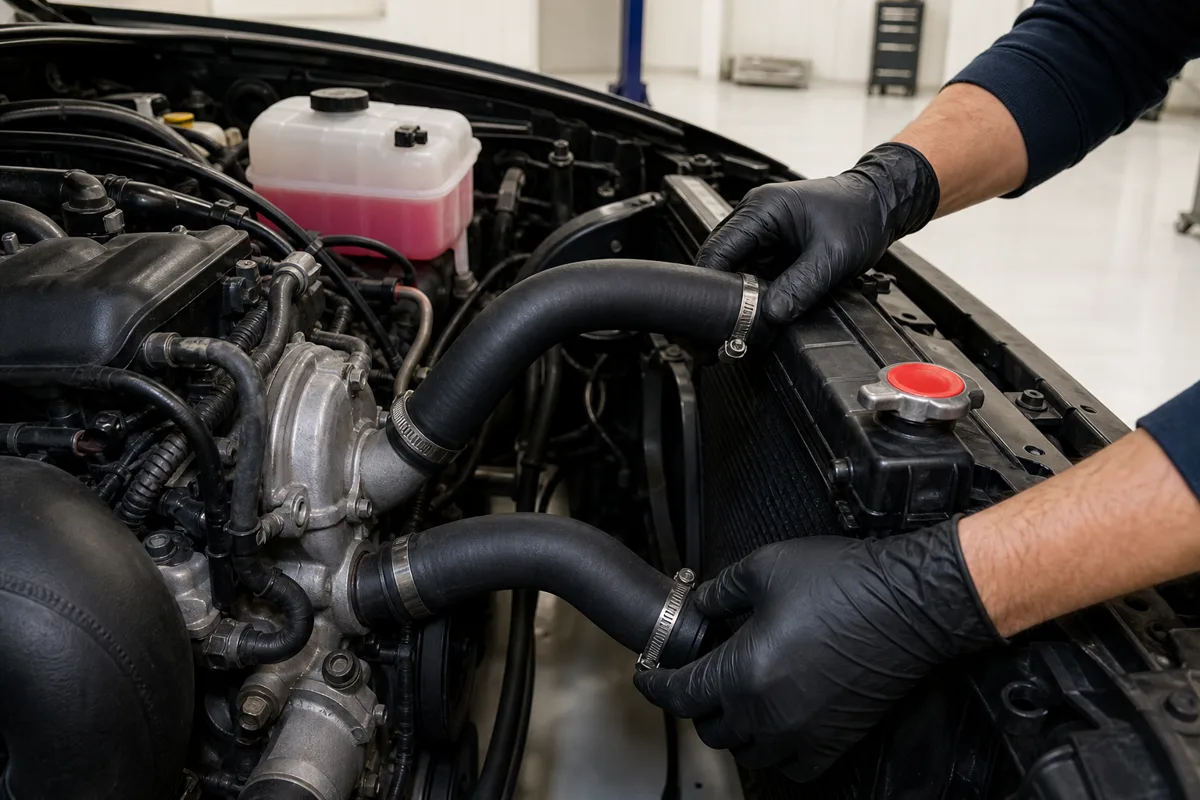
A swollen upper radiator hose is easy to spot. What is harder to see is the aging lower hose, hardened clamps, and brittle bracket mounts that will fail weeks after a single-hose swap. Cooling systems operate as a network — partial repairs rarely hold under thermal expansion.
Why Single-Hose Replacement Fails
Inlet and outlet hoses experience different stress profiles. The upper hose endures peak heat exposure near the thermostat housing, while the lower hose handles sustained pressure from the water pump. Replacing only the visibly damaged hose leaves weakened companions that fail under the next heat cycle.
Clamps lose tension over time. Reusing them on new rubber creates uneven compression that cuts into the hose wall and causes seepage at the collar edge.
Full Revision Protocol
Our cooling revision includes replacement of inlet and outlet hoses, new constant-torque or OEM-spec clamps, and inspection of supporting brackets and guide clips. Hose routing is verified to prevent contact with moving or hot components that accelerate wear.
We also evaluate adjacent components — radiator end tanks, heater core lines, and overflow connections — for signs of age that could compromise the repair if left unchanged.
Pressure Testing Procedure
After installation, the system is filled with the correct coolant mix and purged of air locks. A pressure test confirms seal integrity at operating pressure levels before the vehicle leaves the bay.
We monitor for slow drops that indicate micro-leaks at clamp interfaces — failures that often appear only after the engine reaches full operating temperature on the road.
Signs Upstream Service Is Needed
Discolored coolant, oily residue in the overflow tank, or recurring overheating despite new hoses may indicate radiator internal corrosion or water pump bearing wear. Identifying these conditions during hose revision prevents a third visit for a related failure.
Documenting fluid condition and pressure test results gives you a clear picture of cooling system health and expected service life after the revision is complete.