Intermittent misfires are among the most frustrating electrical faults because they often disappear during a standard scan and reappear under load, heat, or humidity. Long before a check-engine light stores a permanent code, insulation in coils and armored wiring begins to degrade.
Early Warning Signs
Drivers frequently report rough idle, hesitation during acceleration, or a brief stumble that clears within seconds. These symptoms suggest arcing or resistance spikes that occur only when voltage demand peaks.
Visual inspection rarely reveals the fault. Cracks in coil boots and micro-fractures in shielded wiring are often invisible until tested under operating conditions.
Measurement Techniques We Use
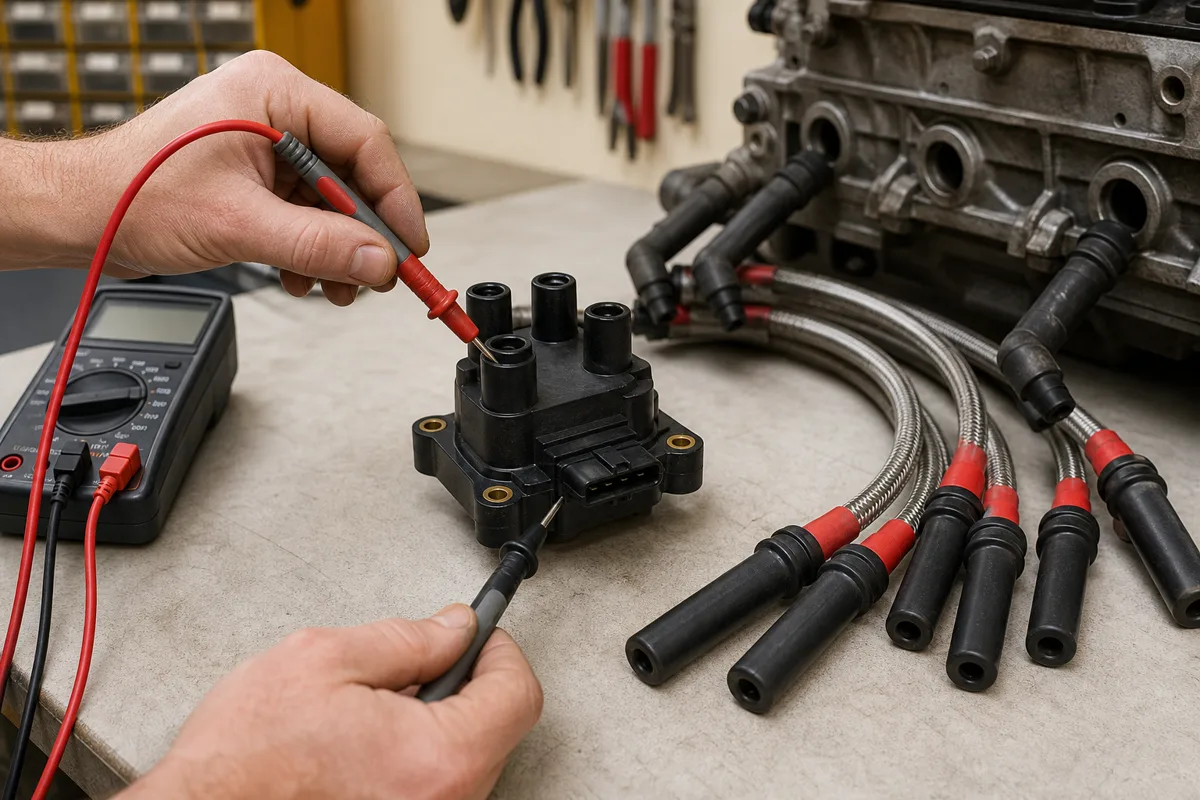
Our electrical bay combines scope analysis with resistance and insulation tests. We compare cylinder-to-cylinder waveforms to identify irregular spark duration and voltage drop patterns that indicate failing components.
Armored wire is tested for continuity and shield integrity along its full routing path — not just at connector ends. Heat damage near exhaust components and chafing against brackets are common failure points on high-mileage platforms.
Why Matched Coil Sets Matter
Replacing a single coil on a multi-cylinder engine leaves older units with uneven internal wear. The newest coil fires strongly while weakened neighbors struggle, creating imbalance that accelerates further degradation.
When testing confirms failure in one coil, we evaluate the full set. Replacing coils as a matched group restores uniform output and reduces the likelihood of repeat misfire codes within a short service interval.
Post-Repair Validation
After replacement, we verify results with a loaded road test and secondary waveform capture. This confirms that ignition events remain stable across RPM ranges and that no secondary wiring faults remain active.
Documentation includes baseline and post-repair data so future technicians can compare performance if symptoms reappear months later.